Our Mold Removal Services
Inspection through clearance testing, handled by one local crew — with the moisture source fixed, not just the growth.
Explore our most requested mold removal and inspection services, trusted by Baton Rouge homeowners and business owners alike. Every one of them begins with the same free on-site inspection and a written, flat-rate scope — there is no such thing as an estimate that moves once work starts.
One Company, Start to Finish
Inspection, testing, containment, removal, drying, and clearance are all performed by our own crews. Nothing gets subcontracted out and handed back to you with a gap in the paperwork.
The Source, Not Just the Stain
Every scope includes finding and correcting the moisture problem that created the growth. Remediation without that step is a temporary result with a guaranteed return date.
Independently Verified
Post-remediation clearance testing is done by a third-party lab, not by us. If the space does not pass, we return at our cost until it does.
Mold Inspections & Testing

Every job starts here, and the inspection is free. A technician walks the property with a moisture meter and a thermal camera, looking for the temperature differentials that reveal wet material behind an intact surface. Visible growth is the easy part; the point of an inspection is to find what you cannot see.
Where the situation calls for it we take air samples and surface swabs and send them to an independent lab. That tells you the species and the spore count — the difference between ordinary Cladosporium on a bathroom ceiling and Stachybotrys in a wall cavity, which are two very different scopes of work.
You leave the inspection with a written report: where the moisture is, where the growth is, what caused it, and a flat-rate price to fix it.
Lab numbers are easy to over-read. EPA’s page on mold testing and sampling makes the point that there are no federal standards for acceptable indoor mold levels, so a spore count means something only next to a visible source and a moisture reading. That is the same reason a report worth having names where the water is coming from, not just what grew.
Mold Remediation

Remediation performed to the IICRC S520 standard. Sealed containment goes up around the work area and a negative air machine with HEPA filtration keeps the pressure inside lower than the rest of the building, so spores disturbed during removal cannot travel into clean rooms.
Contaminated porous material — drywall, insulation, carpet, pad, sometimes framing — is cut out and bagged inside the containment. Salvageable non-porous surfaces are HEPA-vacuumed, wiped, and treated with an antimicrobial. Then the structure is dried with air movers and dehumidifiers until moisture readings match unaffected areas.
Most residential projects run one to three days of active work plus drying time. Larger flood-related jobs can run a week or more. You get a schedule at the estimate and we hold to it.
Anyone who wants to see the underlying method before signing something can read it directly. EPA’s mold cleanup guidance sets out how the size of the affected area changes the approach, why containment exists at all, and what happens to porous materials like drywall paper and carpet padding once they have been wet long enough.
Air Quality Testing & Odor Removal
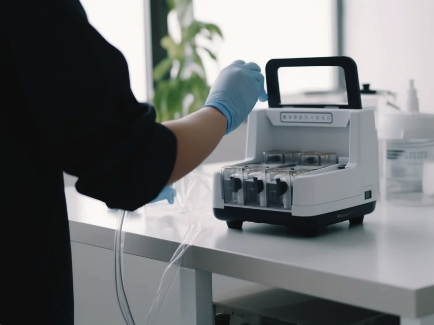
Post-remediation verification is not optional on our jobs. An independent lab — not us — samples the treated space and compares the spore count against an outdoor control. If it does not clear, we go back in at our cost.
We also handle the part people actually notice: the smell. Musty odor is microbial VOCs, and it survives long after the growth is gone if the source material is still in the building. Hydroxyl generators break those compounds down rather than covering them with fragrance.
HVAC systems get their own attention. A contaminated air handler or duct run will reseed a clean house within weeks, so ducts are inspected and decontaminated as part of the scope whenever the system ran while the growth was active.
Black Mold Removal

“Black mold” usually means Stachybotrys chartarum, which needs material that has stayed saturated for days — so finding it is almost always a sign of a leak nobody knew about, or flood water that was never properly dried.
It is handled with the most conservative protocol we run: full containment, respirators and disposable suits for the crew, sealed disposal of every affected piece of drywall, insulation, carpet, and framing member, and clearance testing before the containment comes down.
Do not disturb it yourself. Scrubbing releases an enormous spore load into the air and spreads a contained problem through the whole house. If you think you have found it, close the door to the room and call us.
Water Damage & Flood Cleanup
The cheapest mold job is the one that never becomes a mold job. Mold needs roughly 24 to 48 hours on wet material, so the single biggest factor in what a loss ends up costing is how fast the water comes out and the structure dries.
We handle extraction, structural drying, and dehumidification after storms, slab leaks, burst supply lines, sewer backups, and appliance failures. Moisture readings are logged daily so there is a documented record that the building actually reached dry standard — which is also what an adjuster wants to see.
Emergency dispatch runs 24/7 across Baton Rouge and the surrounding parishes.
Flooding puts a different problem in front of a Baton Rouge homeowner than a burst supply line does, because floodwater carries contamination in with it. EPA’s flood cleanup and indoor air quality resources collect what that changes — which materials come out rather than dry in place, how long a structure can sit before growth starts, and what to do about an HVAC system that ran while the building was wet.
Crawl Space & Attic Mold
These two spaces are where Baton Rouge mold usually starts, because both are unconditioned, both are humid, and neither is somewhere anyone looks until there is a smell in the living space above or below.
In crawl spaces the culprit is normally a torn or missing vapor barrier, standing water from poor exterior drainage, or vents that pull humid summer air onto cool subfloor framing. In attics it is bath fans dumping into the attic instead of outside, insufficient ridge and soffit ventilation, or a roof leak tracking along the sheathing.
We remediate the growth, correct the ventilation or vapor problem that caused it, and where appropriate encapsulate the space so it stays dry. Fixing the mold without fixing the airflow just buys a year.
24/7 Emergency Response
Water does not respect business hours. We dispatch around the clock for active intrusion across East Baton Rouge, Livingston, Ascension, and West Baton Rouge parishes.
On an emergency call the first priorities are stopping the source if it is still running, extracting standing water, and getting air movers and dehumidifiers in place. Documentation starts immediately — dated photos and moisture readings from hour one are what make an insurance claim straightforward later.
Call (225) 960-6999.
Not Sure Which One You Need?
- A musty smell with no visible growth → start with an inspection
- Visible spotting under 10 sq ft on a hard surface → inspection, then targeted remediation
- Anything behind a wall, in an attic, or under a floor → full remediation
- Standing water right now → emergency response, before it becomes a mold job
- Selling or buying, and need documentation → testing with a clearance report
Schedule Your Mold Inspection Today
Reach out now to book your free consultation and take the first step toward a healthier, mold-free property.